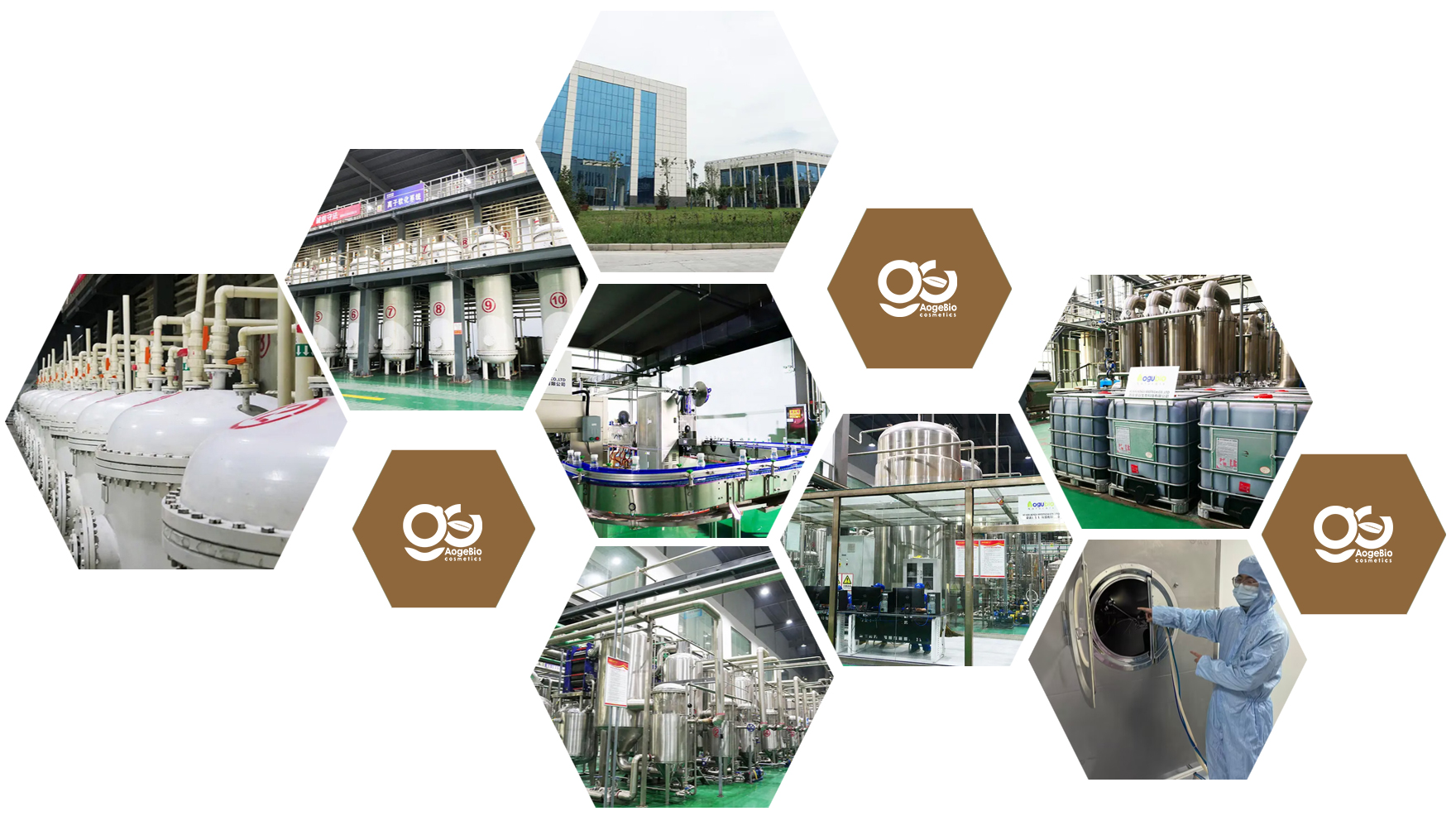
Founded in 2013 and headquartered in the prestigious high-tech zone of Xi'an, Xi'an Aoge Biotech Co., Ltd., along with its subsidiaries Xi'an Imaherb Biotech Co., Ltd. and Xi'an Nahanutri Biotech Co., Ltd., has established itself as a leading force in the cosmetics raw materials industry.
Our expansive cooperative factory, spanning 1,000 mu (approximately 165 acres), is equipped with state-of-the-art extraction technology. This advanced infrastructure allows us to manufacture a wide array of premium cosmetic raw materials. Our product line includes natural plant extracts specifically designed for organic cosmetics, as well as synthetic ingredients for high-end skincare formulations. These raw materials serve as the foundation for a multitude of skincare, haircare, and makeup products, ensuring superior quality and efficacy throughout the entire production process.
Our in-house laboratory is equipped with cutting-edge instruments for rigorous quality control. We utilize UPLC and HPLC for analyzing active components, GC and GC-MS for detecting solvent residues, ICP-MS for identifying heavy metals, and GC/LC-MS-MS for assessing pesticide residues. Additionally, we employ HPTLC and IR for identification purposes, ELISA for determining ORAC values, PSL for evaluating irradiation residues, and conduct comprehensive microbiology tests. These measures guarantee that our raw materials adhere to stringent international standards, enabling us to deliver highly pure and consistent ingredients essential for developing next-generation moisturizing and barrier-repair skincare lines.
At Aogebio, innovation, quality, and sustainability are the bedrock of our corporate philosophy. These pillars empower us to continuously innovate and deliver excellence in the cosmetics raw materials industry.
Beta-Arbutin, a naturally derived glucoside, has emerged as a highly sought-after cosmetic ingredient due to its multifunctional properties. Traditionally recognized for skin brightening effects, recent advances have proven Beta-Arbutin to play a pivotal role in moisturizing formulations and skin barrier repair products. The unique molecular structure enables not only melanin reduction but also enhanced skin hydration and protection from environmental aggressors.
In the global cosmetic market, consumer awareness about the importance of skin barrier health is increasing rapidly. Damaged or weakened skin barriers lead to moisture loss, irritation, and accelerated aging. Beta-Arbutin's application in moisturizing product lines offers a dual benefit: it restores pigmentation uniformity while improving skin resilience by supporting ceramide synthesis and reducing transepidermal water loss (TEWL). Consequently, skincare brands harness Beta-Arbutin to develop next-generation formulations that provide long-lasting hydration and fortify the skin barrier against pollutants and allergens.
Industrial trends reveal growing investments toward optimizing Beta-Arbutin derivatives with enhanced bioavailability and skin compatibility. Manufacturers are innovating extraction and purification techniques to improve stability and reduce degradation, expanding its usability in various cosmetic formats including serums, creams, emulsions, and even mask products focused on barrier repair. Additionally, interdisciplinary research merges Beta-Arbutin with complementary actives such as Beta Glucan and Hyaluronic Acid to create synergistic moisturizing systems with superior efficacy.
Beyond cosmetic use, Beta-Arbutin shows promise in cosmeceutical and dermatological applications where skin barrier impairment is a prominent concern — for example, addressing atopic dermatitis or sensitive skin conditions. Thanks to its anti-inflammatory and antioxidant properties, Beta-Arbutin-based formulations help soothe irritation while reinforcing the skin’s natural defenses, making it a versatile raw material for premium moisturizing and barrier-repair product lines.
In conclusion, Beta-Arbutin stands at the forefront of moisturizing and skin barrier product innovation. The ongoing industrial advancements and expanding clinical evidence highlight its critical role in shaping the future of skincare — offering brands an ingredient that aligns perfectly with modern consumer demands for efficacy, safety, and sustainability.